


 Add Category
“If you are running the main tennis tour, you have the freedom to ban players, but you have to be able to show this course of action is reasonable,” an unnamed club source reportedly told the UK Daily Telegraph. “Russian players could argue that they are being prevented from making a living through no fault of their own. That is not so much of an issue for Wimbledon, however.”
It is some turnaround. For decades, sportspeople have been condemned when they have allowed their political beliefs to overlap with their performances. Back in 1980, the captain of Australia’s Olympic swimming team, Mark Morgan, personally boycotted the Moscow Olympics because he disagreed with the Soviet Union’s invasion of Afghanistan. Most of the team went, under the banner of ‘politics and sport don’t mix’. Cathy Freeman was reprimanded for carrying the Aboriginal flag, a political symbol, after winning a Commonwealth Games gold medal. Tommie Smith and John Carlos were ostracised for their black power salute on the Olympic podium in Mexico City in 1968. There is a long and lively and ultimately productive debate about the rights of sportspeople to use their privileges to express their heartfelt political views.

Belarus’s Aryna Sabalenka, the women’s world No.4.Credit:Getty Images
Flipping all of that on its head, Medvedev and Sabalenka are now banned for not making political statements; for just wanting to be tennis players; for keeping politics separate from their sport. If it is to happen, it opens some disturbing precedents.
We don’t know Medvedev’s reasons for not making strident anti-Putin public statements. He might be scared for his family or otherwise intimidated. He might be brainwashed into thinking Ukraine needs to be cleansed of neo-Nazis. He might be dull or stupid. He might love his nation’s ruler. He might, like countless athletes before him, be a blind, proud and genuine patriot: Mother Russia, right or wrong.
None of these motivations would make Medvedev any different from most athletes around the world, who prefer to be left in their bubble to pursue improved performance. What does make Medvedev’s case different is that the Russian invasion has created a rare international unity of opinion (as long as you subtract the two biggest countries in the world, China and India, plus a lot of others who have not condemned Russia; their athletes are presently unencumbered by demands to sign any statements).
So powerful is the feeling against Putin, in the tennis-playing West at least, that the fear of Medvedev raising the Wimbledon trophy in June is so gut-wrenching that any steps are justifiable to prevent it from happening.
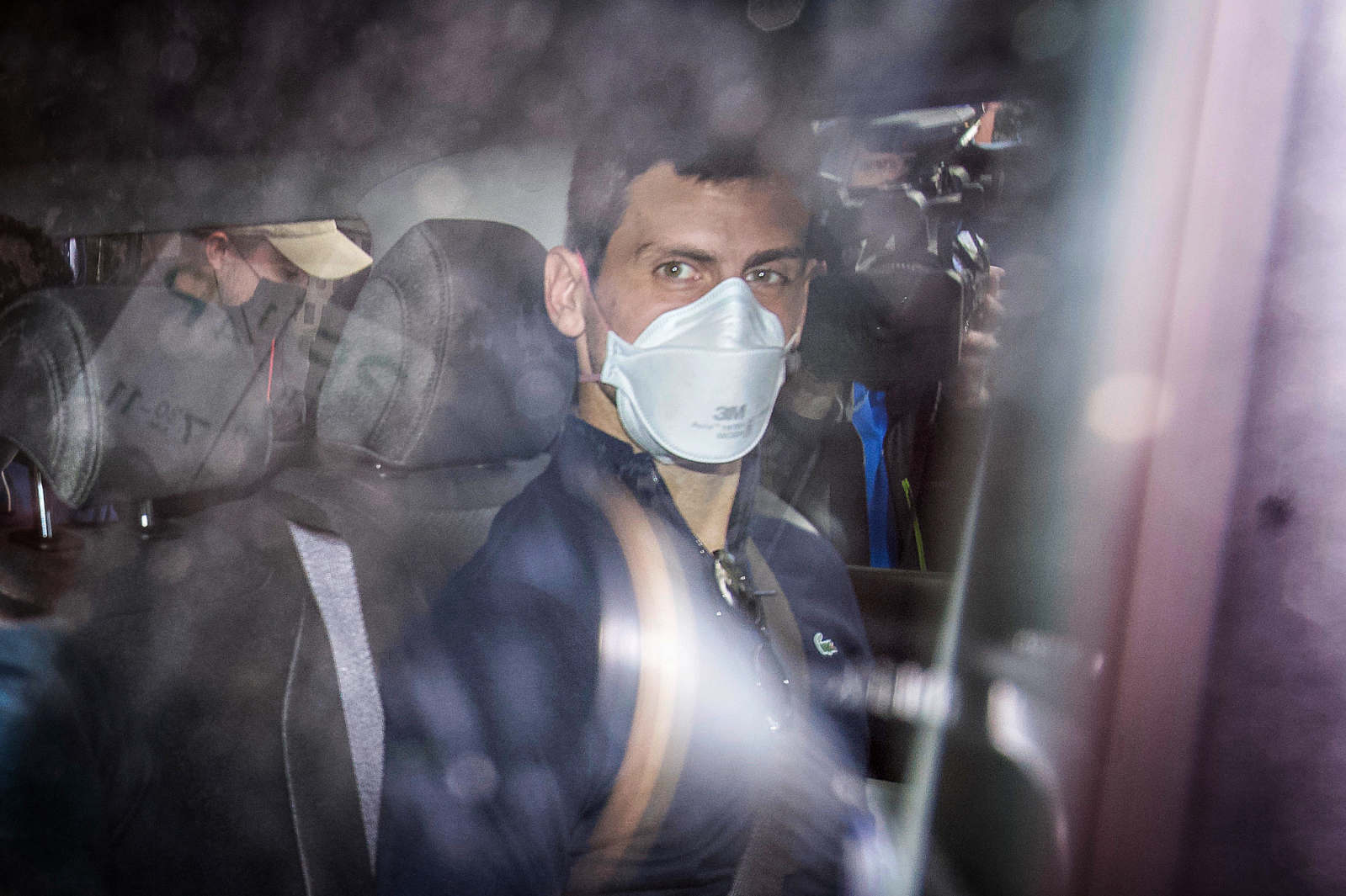
Novak Djokovic was deported from Australia because he might foment anti-Covid vaccination sentiment.Credit:Luis Ascui
But wait, wasn’t this what happened to Novak Djokovic, deported from Australia in January because he became a political problem for the federal government? Australia’s immigration minister Alex Hawke, in his Federal Court of Appeal argument, said Djokovic had to be deported because he might foment anti-Covid vaccination sentiment. Wasn’t this another imposition of politics on a sportsperson who just wanted to be left alone to play tennis?
The parallels can be taken too far, however. Djokovic, via his enablers at Tennis Australia, was asking for an exception to be made for him against public health rules that applied to others. He was thrown out because he might influence others. He saw himself as a freedom fighter for a cause which can affect the health of entire communities. So even if it was under the guise of a public health debate, Djokovic was actively leading a political movement with potentially serious consequences.
Can Medvedev be accused of any of that? His silence on Russia’s invasion of the Ukraine influences exactly nobody. He does not see himself as a leader; his every indication is that he wishes the whole conflict would disappear. In Australia it was the government that employed a convenient legal fiction to win its case, interpreting its own laws and the political consequences, throwing Djokovic out against the desires of the tennis tournament.
In Britain, by contrast, the government would presumably let Medvedev in – how could it not, without politically persecuting him? – whereas it is the private tennis club, running its own rules, that may prevent him playing, purely because of the prospect of a Russian winning Wimbledon and embarrassing everyone, even if he is playing under no national flag.
It shows how the Djokovic affair, interpreted in different ways around the world, is still going to set some awkward precedents. Will other sporting organisations require sportspeople to sign political statements? What future tyrannies of majority opinion can be held over individuals?
Loading
What if some future Lleyton Hewitt has to take accountability for his country’s life-destroying policies? Come on! Sportspeople who take political stances to stimulate debate or raise awareness are very often, in the fullness of time, admired. What of a sportsperson who wants to abstain from groupthink?
For spectators to boo Medvedev at Wimbledon, or for protestors to wave anti-Putin banners, would be a democratic way of getting a message across. But oh so unseemly at SW19. Far more convenient is a pre-emptive strike.
It may be academic anyway. Medvedev earlier this month underwent surgery for a hernia that might rule him out of both Roland Garros and Wimbledon. Perhaps, where the mouth stays silent, a rebellious body does all the talking.
News, results and expert analysis from the weekend of sport sent every Monday. Sign up for our Sport newsletter.